

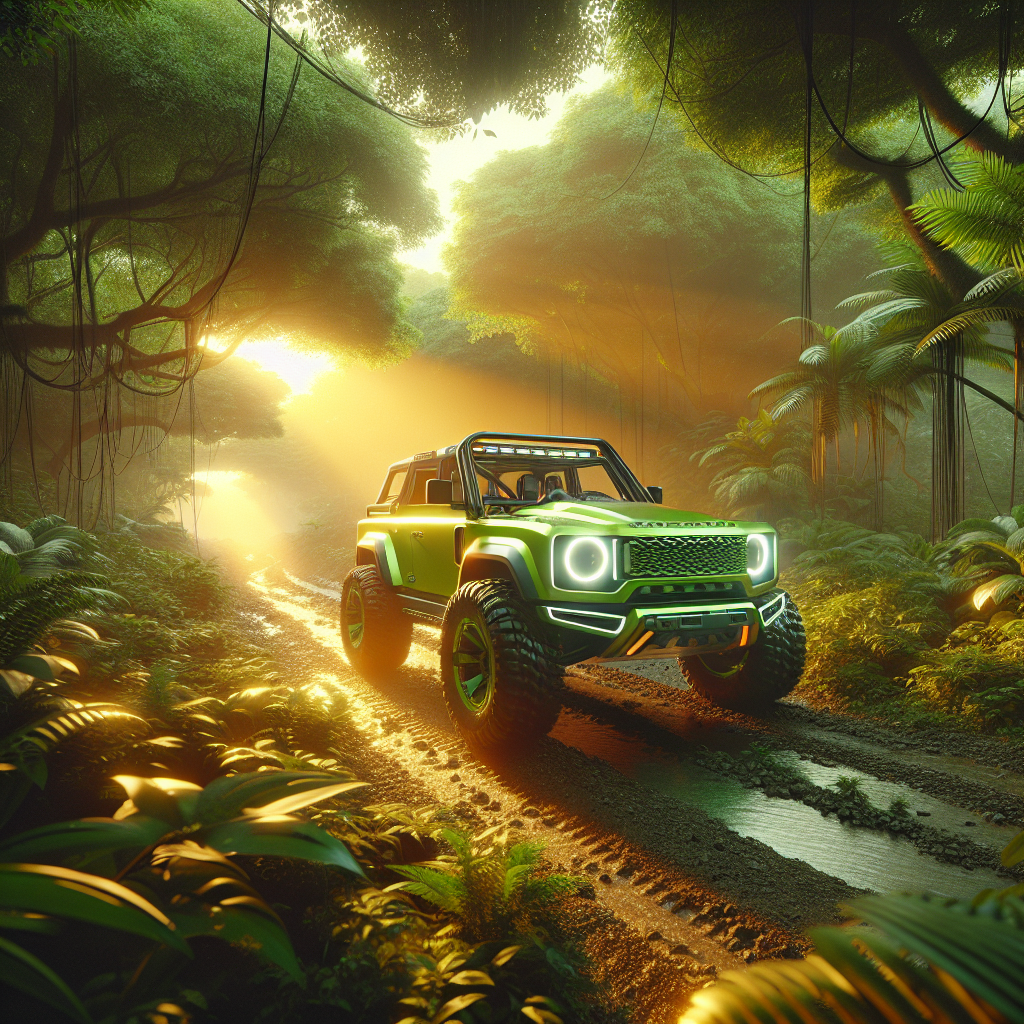
Why the Jeep Trailcat is Still the Ultimate Dream Build in 2026
Ever wonder what happens when absolute insanity meets brilliant engineering? The Jeep Trailcat is exactly that—a 707-horsepower monster that absolutely should not exist, yet it totally rules the dirt. Look, it is officially 2026, and while everyone else is arguing about battery ranges, charging station locations, and perfectly silent off-roaders, I am still obsessing over the supercharged scream of a Hellcat V8 stuffed into a Wrangler chassis.
Let me tell you about a massive local 4×4 meet I attended just last month. I was standing next to a perfectly restored classic CJ-7, casually sipping my morning coffee, when the ground beneath my boots literally started shaking. A buddy of mine managed to build a near-perfect replica of the legendary concept vehicle. When he revved that 6.2L V8 engine, the entire electric-vehicle crowd totally froze in their tracks. That mechanical sound is purely primal. The concept originally debuted a full decade ago, but the obsession within the off-road community has only grown exponentially over the years.
If you genuinely love massive tires, absurd horsepower figures, and going extremely fast over things that should realistically stop a military tank, you need to understand the sheer magic behind this specific machine. We are going to unpack exactly why this vehicle remains the undisputed king of off-road fantasy builds, how the complex mechanics actually work under heavy stress, and what it truly takes to replicate that visceral experience right now. Expect no fluff, just pure V8 madness and elite suspension magic. It completely redefines what it means to go completely off the grid and push an internal combustion engine to its absolute physical limits.
What Makes the Trailcat Absolutely Unstoppable?
The core idea behind the Jeep Trailcat is delightfully unhinged: take the absolute fastest street engine Dodge manufactures, severely stretch a standard Wrangler frame to fit it, and bolt it all together with heavy-duty hardware. It serves as the ultimate middle finger to traditional slow-crawling off-road logic. Instead of meticulously creeping over sharp rocks at three miles per hour, you are launching over them like a professional Baja desert racer.
Think about the actual value proposition here. First, consider the sheer power delivery. When you are deeply stuck in thick, viscous mud, wheel speed is your absolute best friend. A standard V6 engine simply bogs down under the immense resistance; a 707-HP supercharged V8 spins massive 39.5-inch mud tires fast enough to clean the thick treads instantly, launching you forward. Second, evaluate the extended wheelbase. By deliberately stretching the heavy steel frame by exactly 12 inches, automotive engineers created incredible high-speed stability. It simply does not get twitchy or dangerous when you decide to do 80 mph across a completely dry lake bed.
Let’s look at the hard mechanical numbers. Here is exactly how the legendary concept stacks up against its closest factory-built siblings:
| Vehicle Specification | Jeep Trailcat Concept | Wrangler Rubicon 392 | Grand Cherokee Trackhawk |
|---|---|---|---|
| Engine Horsepower | 707 HP Supercharged V8 | 470 HP Naturally Aspirated | 707 HP Supercharged V8 |
| Overall Wheelbase | 108.4 inches (Stretched) | 118.4 inches (Standard 4-door) | 114.7 inches (Standard SUV) |
| Transmission Type | 6-Speed Heavy Duty Manual | 8-Speed Automatic | 8-Speed Automatic |
Why is this specific mechanical combination so highly effective? Here are the top three reasons hardcore off-roaders consistently try to copy this exact blueprint in their home garages:
- Insane Power-to-Weight Ratio: Even burdened with heavy, cast-iron Dana 60 solid axles, possessing 707 horsepower means you can effortlessly out-accelerate exotic sports cars on loose dirt surfaces.
- Custom Geometrical Balance: The 12-inch frame stretch isn’t just for aggressive visual looks; it physically prevents the short-wheelbase Jeep from dangerously flipping backward during hard drag-strip style launches.
- Bulletproof Analog Drivetrain: Mating the violent Hellcat engine to a heavy-duty 6-speed manual transmission gives the skilled driver total, unfiltered analog control over all that mechanical chaos, rather than relying on computer-shifting.
It is definitely not just a quick swapped engine; it is a comprehensively re-engineered, purpose-built platform. The custom interior modifications also play a massive role in the driving experience. Borrowing lightweight carbon-fiber bucket seats directly from the Dodge Viper means you actually stay securely planted when the heavy vehicle inevitably gets airborne. Most off-roaders violently bounce around the cabin, but this setup locks you tightly into the aggressive driving experience. Driving one literally feels like riding a mechanical bull that you somehow maintain total control over. You push the accelerator pedal, hear the aggressive supercharger whine, and the horizon blurs instantly.
The Origins of the Concept
Back in the spring of 2016, the specialized engineering team at Mopar and Jeep collectively decided to build something incredibly special for the 50th annual Easter Jeep Safari out in Moab, Utah. At the time, the wild idea of a factory-backed Hellcat-powered Wrangler was just a massive, unverified internet rumor floating around enthusiast forums. The engineers fiercely wanted to prove they could actually make the massive block fit inside the cramped engine bay. The entire project was initially shrouded in corporate secrecy. They started out with a completely standard two-door Wrangler platform, but immediately realized the stock physical dimensions simply could not handle the sheer violence of a supercharged 6.2-liter engine. Consequently, the heavy cutting wheels came out, and the frame was chopped.
Evolution and The Shift to Production Ideas
After the heavily modified Trailcat officially debuted, the internet practically broke. Global automotive forums violently exploded with digital petitions practically begging the company to mass-produce the green monster. While the corporate executives never sold the exact Trailcat concept to the general public, the massive shockwaves of that specific Easter Jeep Safari build changed everything. It conclusively proved the market was starvingly hungry for massive V8 power housed inside a Wrangler body. Fast forward a few highly anticipated years, and we successfully got the Wrangler Rubicon 392. While that naturally aspirated 470-HP machine is objectively incredible, purists have always quietly viewed it as the original concept’s much tamer, slightly more polite younger brother.
The Modern State of Hellcat Wranglers in 2026
Now that we are completely deep into 2026, the custom off-road build scene has completely taken over exactly where the factory unfortunately left off. High-end custom automotive shops across the globe are routinely building stunning “Trailcat clones.” Since the original 6.2L crate engines are highly sought after and incredibly expensive, finding a clean donor block has actively become a highly competitive sport among wealthy off-road builders. The vast aftermarket industry has fully caught up, easily producing mass-market bolt-on frame stretch kits, custom carbon-fiber driveshafts, and heavily reinforced Dana 60 axles specifically designed to comfortably handle 650+ lb-ft of torque. The original 2016 concept is absolutely no longer just a static museum piece; it remains the definitive engineering blueprint for the ultimate off-road flex. Builders are constantly chasing that original Moab magic, endlessly upgrading custom cooling systems and intricate suspension geometries to comfortably handle the brutal, unforgiving environments of professional desert racing.
Hellcat Engine Mechanics Under Extreme Stress
Let’s talk extensively about the actual applied physics of forcibly putting a 707-horsepower street engine into a solid-axle off-roader. The infamous 6.2-liter supercharged HEMI V8 heavily relies on forced induction to generate power. A massive 2.4-liter twin-screw supercharger forcefully compresses the ambient air before it directly enters the combustion cylinders, consistently running up to 11.6 psi of boost. In a normal street car like the Dodge Challenger, engine cooling is easily managed by massive front-end high-speed airflow. But in a slow rock-crawling scenario where vehicle speeds are low and engine RPMs are held extremely high, thermal heat management rapidly becomes a massive engineering hurdle.
To successfully keep the custom rig from literally melting its own internal components, professional builders actively utilize highly oversized aluminum racing radiators, dual high-flow electric cooling fans, and specialized louvered steel hoods to efficiently evacuate the massive heat soak. If you ever fail to expertly manage the complex thermodynamics, the engine’s onboard ECU will instantly and aggressively pull engine timing, completely robbing you of that legendary horsepower to save the block from catastrophic detonation.
Chassis Dynamics and The 12-Inch Stretch
You strictly cannot just bolt 700+ horsepower into a notoriously short-wheelbase vehicle without blatantly defying basic physics. The stock two-door Wrangler wheelbase is highly susceptible to massive rotational forces—meaning if you aggressively dump the heavy clutch at a stoplight, the front wheels immediately shoot up, and the heavy vehicle risks violently rolling over backwards. By intentionally lengthening the steel frame by exactly 12 inches, brilliant engineers drastically shifted the vehicle’s center of gravity forward and significantly increased the polar moment of inertia.
Here are the absolutely critical scientific facts behind the heavily modified build:
- Extreme Torque Multiplication: Mated securely to a heavy 6-speed manual, the exceptionally lower gear ratios perfectly combined with a specialized transfer case low-range can effectively multiply the engine’s massive 650 lb-ft of torque to over 10,000 lb-ft directly at the wheels.
- Catastrophic Axle Shearing Force: Standard factory axles literally snap like dry twigs under this extreme rotational load. The custom build exclusively uses thick Dana 60 front and rear axles equipped with thicker chromoly steel shafts to safely handle the immense twisting forces.
- Massive Suspension Travel: Premium two-inch Fox racing shocks actively manage the heavy unsprung weight of the massive 39.5-inch BFGoodrich Krawler tires, rapidly dissipating the extreme kinetic energy physically generated during high-speed desert whoops.
- Severe Aerodynamic Drag: With an aerodynamically blocky profile and massive sticky tires, the vehicle’s coefficient of drag is downright terrible, directly meaning the engine has to constantly fight extreme wind resistance at highway speeds, strictly requiring heavily upgraded, high-flow fuel delivery systems to consistently maintain an optimal air-fuel ratio.
Day 1: The Moab Arrival
Let’s aggressively assume you finally get your eager hands on a properly built 2026 Trailcat clone. You absolutely need a worthy, epic itinerary. Here is the ultimate 7-day high-octane desert adventure plan. You roll freshly into Moab, Utah. Start extremely slow. Carefully check all your vital fluid levels, visually inspect the heavy supercharger belt for fraying, and properly torque all your heavy lug nuts. Take the roaring beast on a gentle, scenic shakedown run straight down to the edge of the Colorado River to ensure the operating temps stay perfectly stable.
Day 2: Conquering Hell’s Revenge
Time to rigorously test the mechanical grip. Safely drop your tire pressure completely down to about 10 psi. The incredibly sticky 39.5-inch Krawler tires seamlessly combined with massive V8 grunt will easily let you slowly walk up extremely steep, terrifying slickrock faces without even breaking a nervous sweat.
Day 3: High-Speed Desert Whoops
Leave the slow rocks totally behind and aggressively head to the open, flat dirt expanses. Here is exactly where the 12-inch frame stretch truly shines. Aggressively shift into third gear, heavily hit the gas pedal, and blindly let the tuned Fox shocks violently absorb the massive bumps at 60 mph. It quite literally feels like flying a low-altitude airplane.
Day 4: The Canyonlands Overlook
Take a much slower, incredibly scenic route. The heavy-duty manual transmission smoothly lets you aggressively engine-brake down terrifyingly steep descents flawlessly without ever overheating your brake pads. Just silently listen to the aggressive V8 rumble loudly echoing off the massive canyon walls.
Day 5: Night Run with Lightbars Blazing
Patiently wait for the hot sun to fully go down. Switch on the massively bright custom LED light bars, instantly turning the pitch-black desert as bright as high noon. The piercing supercharger whine violently cuts through the dead silent night air like an angry banshee.
Day 6: Massive Sand Dune Bashing
Find some incredibly deep, soft sand. Normal factory rigs immediately get totally stuck here. You? You just aggressively bury the throttle into the floorboard. The massive wheel speed rapidly paddles the loose sand backwards, forcefully throwing huge, beautiful roosts completely into the sky while you smoothly float right on top of the surface.
Day 7: The Wash Down and Journey Home
Finally hit the local high-pressure car wash. Violently blasting the thick red dirt completely off the bright neon green paint is incredibly visually satisfying. Thoroughly check your battered undercarriage for any fresh battle scars, fill up the large tank with premium 93-octane fuel, and loudly cruise back home on the interstate highway.
Myths & Reality
There is still a massive amount of blatant misinformation actively surrounding this exceptionally wild concept vehicle on the internet today. Let’s conclusively clear it up right now.
Myth: You can conveniently just go buy a Jeep Trailcat straight from the local dealership floor right now.
Reality: Nope. It was strictly built as a highly customized one-off concept vehicle specifically designed for the 2016 Easter Jeep Safari. Any vehicle you actually see on the local road today is a highly expensive, custom-fabricated clone.
Myth: A heavy cast-iron V8 completely ruins the technical rock-crawling capability due to weight.
Reality: While it absolutely does add heavy front-end weight, the massive torque curve readily available at virtually zero RPM actually makes casually getting over massive boulders significantly easier. You strictly don’t have to slip the clutch endlessly to prevent stalling.
Myth: The totally stock, factory manual transmission was actively used in the original build.
Reality: The standard factory Wrangler transmission would physically explode instantly. The brilliant engineers absolutely had to use a heavily reinforced Dodge Viper 6-speed manual transmission to effectively survive the brutal torque output.
Myth: It is physically impossible to properly cool a massive Hellcat engine stuffed inside a cramped Wrangler engine bay.
Reality: It’s exceptionally difficult, but absolutely not impossible. Modern 2026 aftermarket cooling solutions, massive custom-welded aluminum radiators, and proper aerodynamic hood venting make it totally and completely reliable for very long, hot trail days.
FAQ
What exactly is a Jeep Trailcat?
It is a highly specialized, custom off-road concept vehicle originally built by the factory featuring a massive 707-HP Hellcat engine physically stuffed into a heavily modified, stretched 12-inch chassis.
How much raw horsepower does it actually have?
Exactly 707 violently angry horsepower, directly courtesy of a massively supercharged 6.2L HEMI V8 engine.
Can I easily buy one in 2026?
Not directly from the corporate factory line, but premium custom automotive shops will happily build you an exact, flawless replica if your personal banking budget comfortably allows for the massive expense.
What specific size tires are naturally on it?
It aggressively rolls on massively tall 39.5-inch BFGoodrich Krawler T/A KX specialized mud-terrain tires.
Why did the engineers stretch the metal frame?
To physically accommodate the substantially larger V8 engine block, vastly improve high-speed driving stability, and strictly prevent the tall vehicle from dangerously flipping completely over under heavy, sudden acceleration.
Does it feature a standard manual or heavy automatic transmission?
The legendary original concept proudly features an extremely heavy-duty 6-speed manual transmission directly borrowed from a high-performance Dodge Viper sports car.
Is the modern Rubicon 392 literally the exact same thing?
Absolutely not. The factory 392 features a naturally aspirated 6.4L V8 pushing out 470 HP, which is significantly less aggressive and noticeably less powerful than the absurdly supercharged trail monster.
Conclusion
The mighty off-road machine proudly remains an absolute legendary icon of boundary-pushing automotive engineering. Even right now in 2026, it defiantly stands as the absolute ultimate physical test of exactly what violently happens when you completely refuse to compromise between high-speed open desert racing and hardcore, low-speed technical rock crawling. If you ever enthusiastically get the incredibly rare chance to actively ride inside a massively Hellcat-swapped rig, unequivocally take it. The terrifying mechanical sound, the blurry speed, and the sheer undeniable absurdity of the visceral experience will completely ruin driving normal, quiet cars for you forever. Hit up your favorite local off-road fabrication shop, immediately start aggressively saving your cash for that loud supercharger, and proudly go build your absolute dream rig out in the wild!





Leave a Reply