

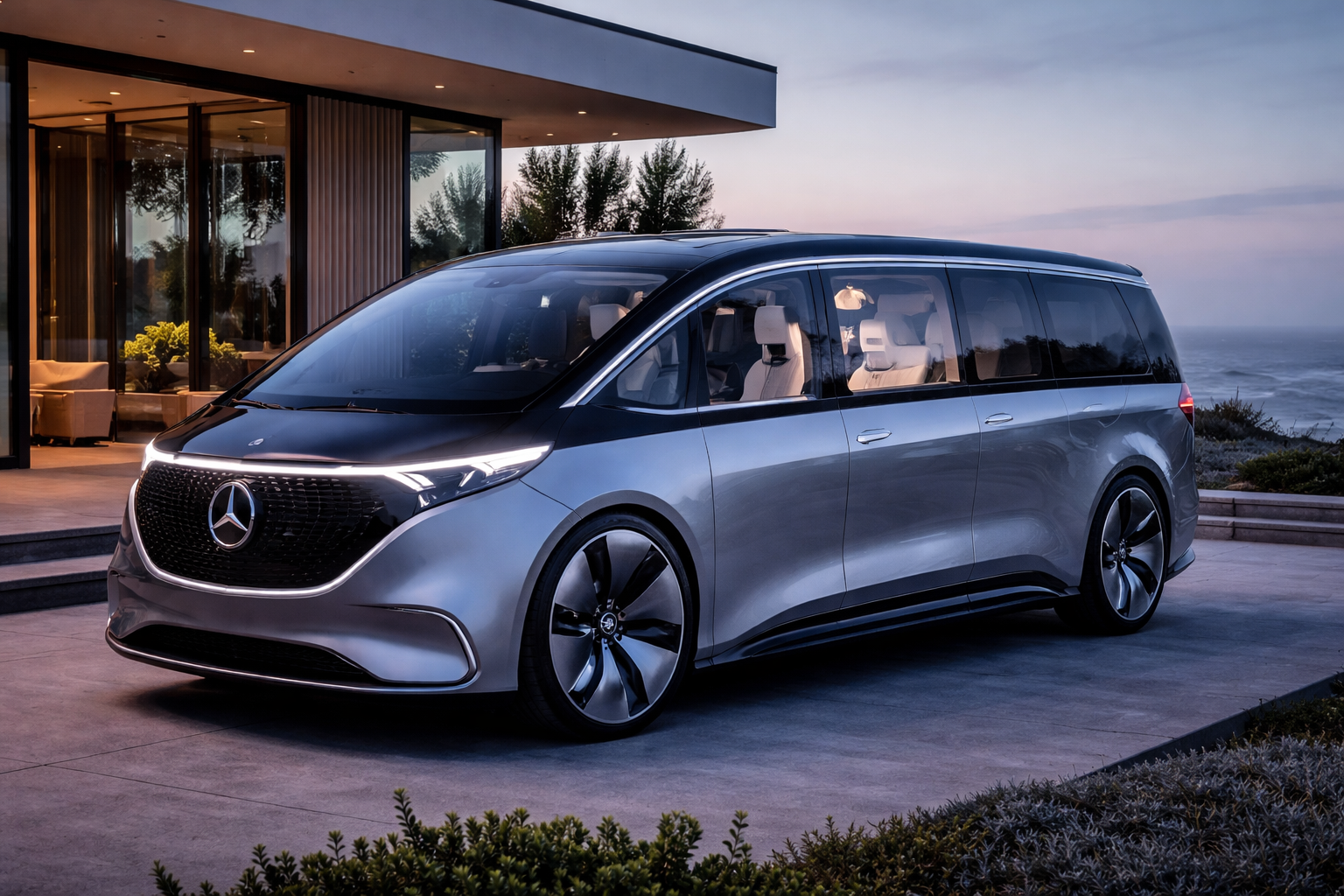
Some concept cars exist to grab a headline and disappear. They show up under bright lights, do their job on social media, and then quietly fade into the giant attic where auto-industry dreams go to collect dust. The Mercedes Vision V does not feel like that. It feels more pointed. More intentional. Less like a random design flex, and more like Mercedes-Benz trying to say, very clearly, that luxury transportation is about to get wider, softer, stranger, and maybe a little more cinematic.
That is what makes this vehicle interesting. Not just the size. Not just the huge screen. Not just the glowing details and soft leather and all the concept-car theater Mercedes knows how to do when it really wants attention. The deeper point is that Vision V suggests a shift in how Mercedes sees premium travel. It is not only asking, “What should a luxury van look like?” It is asking, “What happens when a van stops apologizing for being a van and starts acting like a private lounge?”
And honestly, that is a smart question for the U.S. market right now. Americans still tend to treat vans as practical things first. Family tools. Airport shuttles. Workhorses. Something you choose because you need the space, not because you want to feel glamorous getting into it. Mercedes is trying to push directly against that instinct. Vision V says the space itself can be the luxury. Not a compromise. The point.
That does not mean you can walk into a Mercedes dealership in America and buy a Vision V today. You cannot. This is a concept. That matters. But the concept is not floating in empty air either. Mercedes has tied it to the Van Electric Architecture, or VAN.EA, which the company says will shape its next generation of vans from 2026 onward. So even if the exact show-car drama never makes production unchanged, the direction behind it looks very real.
This is why Vision V matters. It is not just a flashy design study. It is Mercedes testing a whole new lane: the idea that a high-end electric van can sit closer to a chauffeured lounge or rolling suite than to anything Americans usually place in the same category.
What Mercedes Vision V actually is
Let’s keep the basics clear first. The Mercedes Vision V is a concept vehicle, not a confirmed production model with a public window sticker and a dealer order guide. Mercedes-Benz presents it as a luxury limousine concept that previews the brand’s Van Electric Architecture era. In plain English, that means it is showing where Mercedes wants its next generation of high-end electric vans to go, especially the top end.
That distinction matters because concept cars always arrive carrying two versions of themselves. One is literal: the object you see. The other is strategic: the future it hints at. With Vision V, the literal version is wild enough already. Giant screen. Rich materials. lounge-like rear cabin. A design language that looks less like a polite people mover and more like someone merged an executive jet cabin with an art gallery and then added wheels.
But the strategic version is even more interesting. Mercedes is not using Vision V to tease a cheap family hauler with nicer lighting. It is pushing toward a new luxury category inside the van world. And once you see that, the whole concept reads differently. It is not asking for permission to be practical. It is demanding to be seen as aspirational.
- It is officially a concept, not a launch-ready production van
- It is tied to Mercedes-Benz’s VAN.EA future starting in 2026
- It previews the top-end direction of Mercedes luxury vans
- It leans hard into a private-lounge identity rather than a utility-first one
That last point is the heartbeat of the whole thing. Private lounge. Not premium shuttle. Not slightly nicer people carrier. Private lounge.
And yes, the cabin is the headline
You can talk exterior design all day, and we will get there, but let’s be honest: the cabin is why people keep stopping on the Vision V story. Mercedes knew exactly what it was doing here. The rear compartment is where the concept stops being “futuristic van” and becomes something almost theatrical.
Mercedes says the concept includes a retractable 65-inch cinema screen, 42 Dolby Atmos surround-sound speakers, and seven projectors that create a 360-degree digital experience. That alone tells you the brand is thinking about this van less like transport and more like a rolling environment. Not just a place to sit while going somewhere. A place to inhabit. A place to disappear into. That is a very different ambition from the one most automakers bring to a people mover. :contentReference[oaicite:1]{index=1}
Then there is the rest of it. Switchable glass. Reclining first-class-style seats that can flatten out. Storage details that feel more like bespoke furniture than standard automotive packaging. A fold-out table that becomes a chessboard. Ambient lighting everywhere. A fragrance experience. Even by concept standards, it is not subtle. And you know what? It is probably not supposed to be.
Mercedes is basically saying, “If you are going to rethink the luxury van, do not do it halfway.” That is why Vision V comes across less like an incremental update and more like a design team being told to take the category seriously enough to reinvent its emotional appeal.
| Vision V highlight | What it suggests | Why it matters |
|---|---|---|
| Retractable 65-inch cinema screen | Rear cabin as media space | Turns travel into an event, not just transit |
| 42-speaker Dolby Atmos system | Entertainment is central, not secondary | Pushes the cabin toward home-theater territory |
| Seven projectors | Immersive digital environment | Shows Mercedes is thinking beyond ordinary screens |
| Switchable glass | Privacy as a luxury feature | Supports the “private lounge” idea directly |
| Flatbed-capable seats | Comfort over conventional seating norms | Makes the vehicle feel more like first-class travel |
Some of this will almost certainly be toned down for the real world. It has to be. Cost, regulations, durability, weight, usability — all of that shows up eventually and ruins at least a little of the fun. But the emotional message will probably survive: Mercedes wants its next luxury vans to feel like destinations in themselves.
The outside matters too, because it does not look shy
Concept interiors usually get more attention because that is where brands can really indulge themselves. But Vision V’s exterior deserves more than a quick glance. It is doing a lot of work too. Mercedes says the concept uses a chrome-heavy front look, illuminated design elements, a lit hood star, 24-inch wheels, and more than 450 three-dimensional rear light elements. That is not a design brief built around understatement. :contentReference[oaicite:2]{index=2}
And honestly, that is probably the right move. If Mercedes had dressed this concept in soft, anonymous van styling, the entire idea would have collapsed. The exterior needed to tell you, from a block away, that this is not a practical box trying to borrow luxury cues. It is a luxury statement that happens to use van proportions.
That is a harder design task than it sounds. Vans are useful because of their shape. Luxury vehicles are often sold through drama, proportion, and stance. Combining those two instincts without making the result feel absurd is tricky. Vision V does not exactly avoid absurdity, but it does turn it into confidence. It looks like it knows some people will call it excessive. It just does not care.
The result is not elegant in the classic sedan sense. It is something else. More like mobile architecture with jewelry attached. Whether you love that or not may depend on how much patience you have for modern Mercedes showmanship. But at least it is not timid.
Why the van part is the whole point
Here is where this story gets more interesting than “look at the giant screen.” Mercedes is not only pitching a new vehicle. It is trying to elevate a form factor. And that matters in the U.S., where the van image has always had baggage.
American buyers tend to split vans into a few familiar mental categories: family haulers, fleet vehicles, airport transport, maybe a luxury shuttle if you live in the right ZIP code. The van rarely gets treated as a high-design object on equal footing with flagship sedans or SUVs. Mercedes is clearly trying to push against that hierarchy.
In a way, Vision V is saying the old luxury equation may be getting stale. Long hood, low roofline, huge grille, expensive back seat — we know the formula. But what if the best high-end travel experience comes from giving passengers more room, more flexibility, more privacy, and more digital immersion instead of pretending every luxury vehicle has to look like a traditional limousine?
That question lands differently now because EV packaging changes things. Electric architectures can free up space and change cabin priorities. So the “van as premium sanctuary” idea starts to sound less like a niche fantasy and more like a plausible new category.
- More space changes the emotional feel of luxury
- EV architecture gives designers more freedom inside
- High-end buyers increasingly care about experience, not just status symbols
- A van layout can deliver privacy and comfort in ways sedans cannot
That is the real Vision V argument. Not just bigger. Better suited to a different kind of premium life.
What VAN.EA means, and why it matters more than the show-car drama
The glitter is easy to talk about. The architecture matters more. Mercedes-Benz says its Van Electric Architecture, VAN.EA, will underpin all newly developed midsize and large electric vans starting in 2026. That alone makes Vision V more than a design exercise. It ties the concept to a real product strategy, not just a museum piece. :contentReference[oaicite:3]{index=3}
VAN.EA is supposed to be modular, flexible, and scalable. Mercedes says it will support both private and commercial vans, with front modules, scalable center sections, and rear modules that can vary by drivetrain layout. That sounds technical, and it is. But the simple version is this: Mercedes is building a van future that can produce very different vehicles from a common electric foundation.
That matters because Vision V is not floating alone. It is part of a family idea. A proof of how far upward the platform can stretch when Mercedes decides to aim at maximum luxury instead of just utility.
And the U.S. angle here is bigger than people may realize. Mercedes says it plans to offer VAN.EA-based private vans in unparalleled luxury positioning and, for the first time ever in the U.S., a privately positioned midsize luxury van. That is not the same thing as saying Vision V itself is coming unchanged. But it is a very strong clue that Mercedes sees America as a real market for upscale van-shaped vehicles, not just cargo and fleet applications. :contentReference[oaicite:4]{index=4}
| VAN.EA point | What Mercedes says | Why U.S. readers should care |
|---|---|---|
| Starts in 2026 | All newly developed midsize and large vans move to VAN.EA | This is a real timeline, not just concept fantasy |
| Modular and scalable | Different vehicle types can grow from the same EV base | Makes niche luxury vans more plausible |
| Private and commercial branches | Luxury private vans and premium work vans both fit the strategy | Shows this is bigger than one halo concept |
| U.S. private luxury van plan | Mercedes says the U.S. will get a privately positioned midsize luxury van | America is part of the story, not an afterthought |
That is why Vision V feels more serious than some other concept-car spectacles. It is attached to an actual platform strategy with a visible next step.
Will the production version look this wild?
Probably not. At least not all the way. This is where realism needs a seat at the table. Mercedes concept cars are often dramatic on purpose. Production cars usually show up later with fewer glowing party tricks, fewer fantasy materials, and a stronger relationship with manufacturing reality.
So no, I would not expect a one-to-one transfer of every dazzling Vision V flourish into the next real-world Mercedes luxury van. The 65-inch screen may be the kind of feature that gets reinterpreted, reduced, or packaged differently. The exact lighting theatrics will likely calm down. Some furniture-like details may get simplified. That is just how the process works.
But the bigger themes could absolutely survive:
- A far more lounge-like rear cabin
- Higher-end private van positioning
- A stronger tech-and-privacy focus
- A van design that is proud of its presence instead of hiding it
And honestly, those are the parts that matter most anyway. Nobody needs 450 tiny rear lights to understand the direction. The real story is the category shift.
Why U.S. buyers might be more ready for this than they think
This is the part some readers will resist at first. The U.S. is still very SUV-brained. Luxury means big SUVs, big pickups, and maybe a flagship sedan if you are feeling traditional. A luxury van still sounds, to many Americans, like either celebrity transportation or something you only notice at the airport curb.
But that mental picture may be aging out. Buyers are getting more comfortable with experience-first luxury. Families with money care about space. Executives care about comfort and privacy. Chauffeured travel is not going away. And EV layouts make room feel more valuable. Suddenly the idea of a premium electric van stops sounding strange and starts sounding like a smart answer to a question people did not know how to ask before.
That does not mean Vision V becomes a mass-market American obsession overnight. It won’t. But it does mean Mercedes may be arriving early to a category that feels odd now and obvious later. Auto history is full of moves like that. The thing that looks niche before launch becomes easy to explain once the segment exists.
FAQ
What is the Mercedes Vision V?
The Mercedes Vision V is a luxury van concept that previews Mercedes-Benz’s future high-end electric van direction under the Van Electric Architecture, or VAN.EA.
Is Mercedes Vision V a production model?
No. It is a concept vehicle, not a confirmed showroom model in its current form.
What is special about the Vision V interior?
Mercedes highlights features such as a retractable 65-inch cinema screen, 42 Dolby Atmos speakers, seven projectors, switchable glass, flatbed-style seats, and a very lounge-like rear space.
What does VAN.EA mean?
VAN.EA stands for Van Electric Architecture, Mercedes-Benz’s modular EV platform for newly developed midsize and large vans starting in 2026.
Is Mercedes planning luxury private vans for the U.S.?
Yes. Mercedes says it plans to offer VAN.EA-based private vans in the U.S., including a privately positioned midsize luxury van for the first time.
Will the production version keep all of the Vision V concept features?
Probably not exactly. Production vehicles usually tone down concept-car details, but the larger themes of luxury, space, privacy, and immersive technology could carry over.
Why does the Mercedes Vision V matter?
Because it suggests Mercedes is trying to create a new luxury-van category rather than treating vans as purely practical vehicles.
Conclusion
Mercedes Vision V matters because it does not act embarrassed by its own format. It is a van, yes, but Mercedes is using that shape as an advantage rather than a compromise. More room. More privacy. More theatrical tech. More freedom to rethink what premium travel can feel like when you stop forcing every luxury idea into sedan logic.
That is why the concept lands. Not because every detail will survive unchanged, and not because the production future is already fully mapped in public. It lands because the direction is clear. Mercedes is betting that the next meaningful luxury move is not always lower, sleeker, or more coupe-like. Sometimes it is roomier, calmer, and more immersive.
And honestly, that may be the most interesting thing about Vision V. It does not just preview a vehicle. It previews a possible attitude shift. One where the most luxurious seat in the Mercedes lineup might not live in a sedan at all.
If that sounds strange now, give it a minute. A lot of auto ideas do before they stop sounding futuristic and start sounding inevitable.





Leave a Reply