

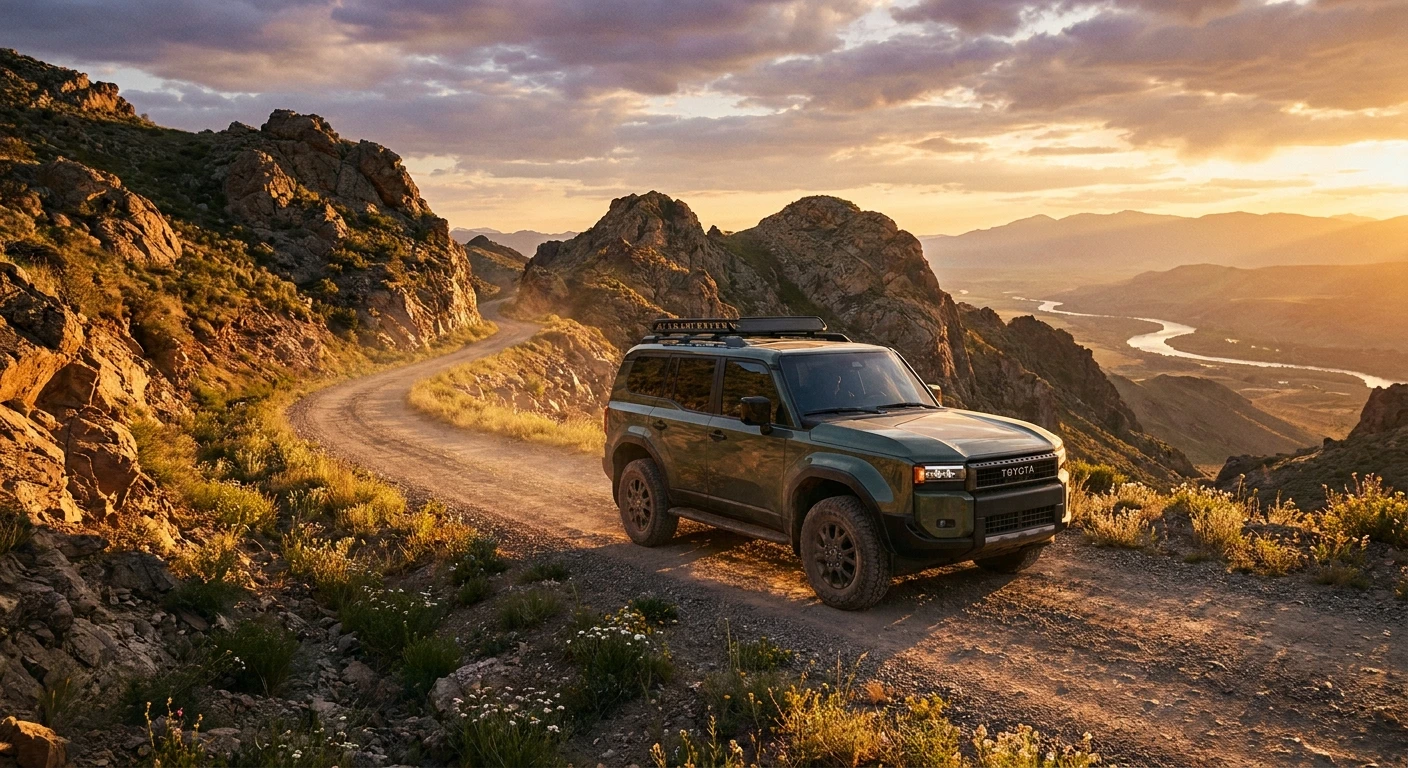
2025 Land Cruiser: The Definitive Guide to the Off-Road Legend
The 2025 Land Cruiser arrives as a masterful engineering achievement, blending decades of rugged heritage with highly efficient hybrid technology. For automotive enthusiasts and dedicated off-roaders alike, this model represents a fundamental shift in how mid-size utility vehicles balance extreme trail capability with everyday driving comfort. Built upon the robust TNGA-F global truck platform, the 2025 Land Cruiser abandons the bloated dimensions of its immediate predecessors in favor of a tighter, more agile footprint. This strategic redesign ensures exceptional approach, breakover, and departure angles, making it a formidable tool for navigating technical terrain. Equipped exclusively with the i-FORCE MAX hybrid powertrain, the vehicle delivers instantaneous torque precisely when traction is scarce. The standard full-time four-wheel-drive system, combined with a two-speed transfer case and an electronic locking rear differential, guarantees that drivers maintain optimal control across mud, snow, and bare rock. By returning to its utilitarian roots while adopting cutting-edge electrification, the 2025 Land Cruiser reclaims its position as the ultimate companion for overland exploration.
Core Capabilities and Everyday Utility
Owning the 2025 Land Cruiser offers a unique duality: it functions as a highly refined daily driver while retaining the mechanical hardware necessary for severe off-road environments. The primary value proposition lies in its uncompromised reliability paired with modern efficiency metrics. Two prime examples demonstrate this balance. First, the hybrid engine’s electric motor provides immediate low-end torque, which eliminates turbo lag during slow-speed rock crawling. Second, the sophisticated suspension geometry absorbs high-speed highway imperfections just as effectively as it handles rutted forest service roads. Buyers can select from distinct configurations to suit their specific requirements.
Read also: Honda Passport 2026: Complete Specs & Redesign Guide; The Complete Guide to the 2024 Mustang.
| Trim Level | Standard Wheel Size | Key Distinguishing Feature |
|---|---|---|
| 1958 Grade | 18-inch alloy | Retro round LED headlamps and durable cloth seating |
| Land Cruiser Grade | 18-inch alloy (20-inch optional) | Rectangular LED headlamps, SofTex upholstery, and Multi-Terrain Monitor |
| First Edition | 18-inch unique alloy | Heavy-duty front skid plate, rock rails, and premium roof rack |
Operating the 2025 Land Cruiser effectively requires understanding its primary mechanical advantages. The following elements elevate its performance above standard sport utility vehicles:
- The advanced Multi-Terrain Select system dynamically adjusts throttle response and brake pressure to optimize traction across various loose surfaces.
- The standard rear locking differential mechanically binds the rear wheels, forcing them to rotate at the same speed for maximum forward thrust during steep ascents.
- The available electronic front stabilizer bar disconnect mechanism (SDM) dramatically increases front-wheel articulation, keeping tires planted on uneven ground.
The Heritage and Evolution of the Icon
Origins of the Land Cruiser Lineage
The history of this legendary nameplate begins in 1951 with the Toyota BJ, a military-derived utility vehicle developed to tackle the most demanding environments on earth. It was originally engineered to scale the steep inclines of Mount Fuji, proving its mechanical superiority early on. The robust ladder frame and simple, highly durable engine set a precedent that would dictate the brand’s engineering philosophy for the next seven decades. These early iterations prioritized survival and functionality above all else, establishing a reputation for unbreakable reliability in harsh climates ranging from dense jungles to arid deserts.
Evolution Through the Decades
As consumer demands shifted, the vehicle evolved through several iconic generations. The J40 series, introduced in the 1960s, cemented the classic boxy aesthetic and introduced civilian comforts while maintaining industrial-grade durability. By the time the J80, J100, and J200 series arrived, the platform had grown significantly in size, weight, and luxury. These later models became the preferred transport for international diplomats and luxury buyers, featuring massive V8 engines, rich leather interiors, and sophisticated hydraulic suspension systems. While they remained exceptionally capable off-road, their high acquisition costs and massive dimensions made them less accessible to traditional off-road enthusiasts.
The Modern State: Return to Roots
The current generation, known internally as the 250-series and marketed as the 2025 Land Cruiser, represents a deliberate pivot back to the vehicle’s origins. Toyota engineers recognized that the previous model had become too expensive and heavy for the core demographic. By slightly reducing the overall dimensions, adopting the shared TNGA-F truck platform, and utilizing a powerful yet efficient four-cylinder hybrid powertrain, the modern iteration captures the agile, purpose-built spirit of the classic J40 and J70 models. It is a calculated return to form, offering serious mechanical hardware wrapped in a functional, retro-inspired exterior.
Technical Architecture and Hybrid Integration
The i-FORCE MAX Hybrid Architecture
At the heart of the 2025 Land Cruiser lies the advanced i-FORCE MAX hybrid powertrain. This system pairs a highly efficient 2.4-liter turbocharged four-cylinder engine with a 48-horsepower electric motor integrated directly into the housing of the eight-speed automatic transmission. This specific placement allows the electric motor to provide seamless torque fill at very low engine speeds, effectively eliminating the lag typically associated with exhaust-driven turbochargers. The result is a highly responsive power delivery system that feels robust during low-speed trail driving and provides confident passing power on the highway, all while achieving significantly better fuel economy than traditional V8 engines.
TNGA-F Platform Dynamics
The foundation of the vehicle is the Toyota New Global Architecture-F (TNGA-F) platform, a high-strength steel ladder frame designed specifically for the brand’s premier trucks and SUVs. This chassis utilizes advanced manufacturing techniques to reduce weight without compromising torsional rigidity. A stronger, stiffer frame allows the suspension components to do their job more effectively, isolating the cabin from harsh impacts.
- Combined system output reaches precisely 326 horsepower and a massive 465 lb-ft of torque.
- The ladder frame utilizes specialized laser blanking and robotic welding processes to increase structural rigidity precisely where stress loads are highest.
- The suspension architecture comprises a high-mounted double-wishbone front setup and a four-link rear suspension with solid axle and coil springs.
- The battery chemistry features a 1.87-kWh Nickel-Metal Hydride (NiMH) pack strategically positioned to maintain optimal weight distribution and preserve cargo volume.
Actionable Trail Preparation Guide
Step 1: Perform the Pre-Trip Mechanical Audit
Before leaving the pavement, drivers must conduct a thorough inspection. Check all fluid levels, verify that tire pressures are lowered to the appropriate level for the expected terrain, and run a quick diagnostic check of the hybrid battery system via the digital driver’s display. Ensure that the full-size spare tire is fully inflated and accessible.
Step 2: Configure Payload and Weight Distribution
Proper weight distribution is critical for off-road stability. Load heavy recovery gear, water containers, and tools low and forward in the cargo area to maintain the vehicle’s low center of gravity. Secure all loose items with heavy-duty tie-downs to prevent shifting during steep ascents.
Step 3: Calibrate the Multi-Terrain Select System
Analyze the immediate trail conditions and engage the Multi-Terrain Select system accordingly. Choose specific profiles such as Mud, Dirt, or Sand. The system will independently adjust the traction control algorithms and throttle mapping to prevent wheel spin and maintain forward momentum.
Step 4: Engage the Center Locking Differential
When transitioning from pavement to loose gravel, sand, or deep snow, activate the 4WD High setting and press the button to lock the center differential. This action ensures power is distributed evenly between the front and rear axles, providing maximum straight-line stability on slippery surfaces.
Step 5: Utilize the Stabilizer Disconnect Mechanism
Upon encountering large boulders, deep ruts, or heavily articulated terrain, activate the front stabilizer bar disconnect system. This allows the front wheels to drop further into depressions and climb higher over obstacles, keeping the chassis level and maximizing tire contact with the ground.
Step 6: Monitor Pitch and Roll via the Camera System
During blind crests or tight technical sections, activate the Multi-Terrain Monitor. Use the high-resolution front, side, and undercarriage cameras to spot sharp rocks, deep crevices, and precise tire placement, avoiding unnecessary damage to the skid plates and sidewalls.
Step 7: Execute Post-Trail Maintenance
After completing the expedition, immediately disengage all differential locks and the front stabilizer disconnect before returning to paved roads. Re-inflate the tires to the recommended highway pressure, and perform a thorough wash of the undercarriage to remove corrosive mud, sand, and debris from the suspension components.
Common Myths vs. Mechanical Reality
Myth: The four-cylinder hybrid engine lacks the raw pulling power of the old naturally aspirated V8 engines.
Reality: The turbocharged i-FORCE MAX hybrid system actually produces significantly more peak torque (465 lb-ft) than the previous generation’s 5.7-liter V8, and it delivers that torque much lower in the RPM range, making it superior for low-speed towing and rock crawling.
Myth: The high-voltage battery pack makes the vehicle unsafe for deep water crossings.
Reality: The entire high-voltage system, including the battery pack and electrical harnesses, is heavily sealed and insulated. The 2025 Land Cruiser maintains robust water-fording capabilities without any risk of short-circuiting.
Myth: It has completely lost its ability to tow heavy equipment.
Reality: While the platform is heavily optimized for off-road agility rather than maximum payload, it still safely and confidently tows up to 6,000 pounds when equipped with the factory-integrated tow hitch.
Frequently Asked Questions & Conclusion
What is the estimated fuel economy?
The hybrid powertrain provides a significant efficiency upgrade, typically achieving a combined rating in the low-to-mid 20s for miles per gallon, depending on driving habits and terrain.
Does the 2025 Land Cruiser offer third-row seating?
No, the current generation is strictly configured as a two-row, five-passenger vehicle to maximize cargo capacity and accommodate the hybrid battery pack.
What is the maximum ground clearance?
The vehicle provides approximately 8.7 inches of standard ground clearance, which can be effectively maximized by choosing the correct driving lines over obstacles.
Does the hybrid engine require premium fuel?
Standard 87 octane unleaded fuel is perfectly acceptable for daily operation, though utilizing premium fuel can optimize performance output under heavy loads.
What size are the standard tires?
Most trims come equipped with 18-inch wheels wrapped in all-season or all-terrain tires, providing thick sidewalls ideal for off-road tire deflation.
Is the front sway bar disconnect standard on all models?
The electronic stabilizer disconnect mechanism is included on the standard Land Cruiser and First Edition trims, but is not available on the base 1958 grade.
What warranty covers the hybrid battery system?
The high-voltage hybrid battery is typically backed by an extensive factory warranty covering 8 years or 100,000 miles, ensuring long-term peace of mind.
Conclusion
The 2025 Land Cruiser successfully bridges the gap between classic utilitarian capability and modern automotive refinement. By combining a highly rigid frame, an advanced hybrid powertrain, and sophisticated off-road software, it stands ready to conquer any trail. Schedule a comprehensive test drive at your local dealership today to experience this remarkable engineering achievement firsthand.





Leave a Reply