

Why Everyone Still Wants a honda motocompo
Listen, I gotta tell you right off the bat, the honda motocompo is literally the coolest piece of retro machinery you will ever lay eyes on. Forget everything you know about standard mopeds or modern electric kick scooters. When you see this rectangular little powerhouse for the first time, it completely changes how you view urban mobility. A buddy of mine over in Kyiv just pulled one of these out of a damp, old storage unit near the Dnipro river. It was completely covered in decades of dust, sitting right next to an old rusty Soviet moped, but the bright red casing was absolutely unmistakable. He wiped off the seat, popped the handlebars up, and we both just stared at it like we had found buried treasure.
We are going to break down exactly why this 1980s folding trunk bike remains an absolute legend, how it actually functions on a mechanical level, and why finding one today feels like striking gold. I will walk you through everything from its incredibly bizarre, yet genius, mechanical setup to a comprehensive step-by-step guide on getting your own up and running. Whether you are a hardcore mechanic or just a fan of weird vintage Japanese engineering, you are going to fall in love with this thing. Let us get right into the nuts and bolts of the greatest tiny motorcycle ever built.
The Core Benefits and Everyday Value of a Micro Scooter
So, why would anyone actually want to ride a bike that looks like a plastic suitcase? The value proposition is actually pretty incredible. First off, it fits entirely inside the trunk of a compact car. You do not need a trailer, you do not need tie-down straps, and you definitely do not need a massive garage. You just fold the handlebars down, drop the seat, and slide it into the back of your hatchback. It is the ultimate last-mile commuter vehicle, designed decades before anyone even knew what ‘last-mile commuting’ meant.
Think about the sheer convenience. You can park your car on the cheap outskirts of the city, pop the trunk, lift out your tiny scooter, and ride directly to your favorite coffee shop right in the bustling downtown core. Plus, it is an instant conversation starter. I have seen guys take these to local car meets, and they get way more attention than the quarter-million-dollar supercars parked next to them. You could also just keep it in the corner of a tiny apartment as a functional piece of art. People love the aesthetic.
| Scooter Configuration | Engine Setup | Top Speed | Wet Weight |
|---|---|---|---|
| Stock Factory Setup | 49cc Two-Stroke | 30 km/h | 45 kg |
| Modified Commuter | Upgraded 70cc Cylinder | 50 km/h | 46 kg |
| Electric Swap Project | 1000W Hub Motor | 45 km/h | 38 kg |
Here are the absolute top reasons you need to experience this machine for yourself:
- Unmatched Portability: It was literally designed to be lifted by one reasonably strong person and placed into a car trunk. The fluid tanks are engineered to prevent spilling when tilted.
- Vintage Aesthetic: The boxy, retro-futuristic plastic fairings scream 1980s cyberpunk. You simply cannot buy anything that looks like this off a showroom floor today.
- Mechanical Simplicity: Being a classic two-stroke engine, there are very few moving parts. If you have basic hand tools and a free weekend, you can fix almost anything that goes wrong with it.
The Wild Origins of the Trunk Bike
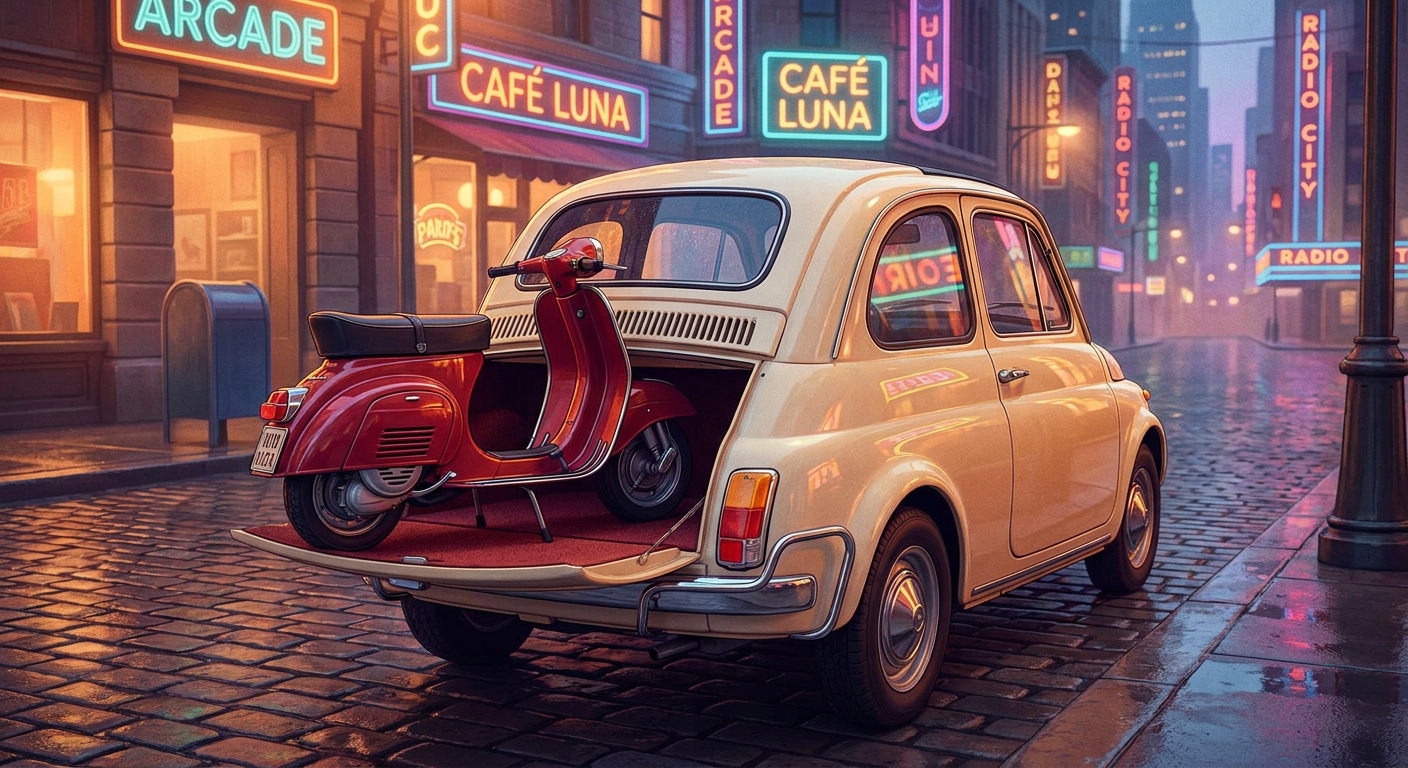
The story behind this machine is absolutely wild. Back in 1981, Japanese engineers were trying to solve the massive problem of urban congestion in cities like Tokyo. Their brilliant idea was to sell a tiny, ultra-compact city car—the Honda City—and offer a perfectly sized moped that fit exactly into its rear luggage area. They literally shaped the scooter’s dimensions around the trunk space of that specific car. It was a complete package. You drove your car until the traffic got too dense, and then you deployed your two-wheeled escape pod.
To sell the concept, they hired the British ska band Madness to do these incredibly catchy, high-energy television commercials. The ads were completely unhinged and amazing, showing people dancing around the car and pulling the bike out of the back. Despite the brilliant marketing, it actually was not a massive commercial success at the time. They originally expected to sell ten thousand units a month, but they ended up barely selling three thousand.
Evolution Through the 1980s
Because the initial sales were somewhat disappointing, production only lasted from 1981 to 1983. That incredibly short production run is exactly why they are so famous today. Over the late 80s and 90s, the remaining units started floating around the used market for practically nothing. Skateboarders, garage tinkerers, and anime fans started picking them up. The scooter gained legendary pop-culture status when it was prominently featured in the classic anime series ‘You’re Under Arrest!’, where the main character used a highly modified, police-liveried version to chase down criminals through tiny alleyways. This exposure completely shifted the public perception from a failed car accessory to a cult-classic icon.
The Modern State of the Classic Scooter
Right now, since the current year is 2026, the nostalgia factor has hit hyperdrive. What used to be a cheap, quirky toy is now a highly sought-after collector’s item. Pristine models are fetching absurd prices at global auctions. The community surrounding them has exploded, with massive online forums dedicated to finding replacement parts, 3D printing broken plastic fairings, and even doing modern battery-electric swaps. It is no longer just a weird novelty; it is a prestigious piece of automotive history that commands serious respect in the vintage community.
Engineering the Foldable Frame
Mechanically, the frame is a masterclass in space efficiency. The engineers had to design a rigid structure that would not fold in half while you were riding, but could easily collapse when you needed it to. They achieved this by using heavy-duty, quick-release cam locks on the handlebars. When you loosen the dials, the bars drop directly down inside the plastic body shell, sitting flush with the top cover. The seat also drops down on a central post, meaning the final folded shape is basically a completely flat rectangle. There are zero protruding parts to snag on your car’s interior.
Two-Stroke Power and Micro-Mechanics
The beating heart of the machine is the AB12E air-cooled two-stroke engine. It is tiny, displacing just 49 cubic centimeters, but it pushes out roughly 2.5 horsepower at 5,000 RPM. Because it is a two-stroke, it has a very snappy, aggressive throttle response. The most fascinating piece of engineering is the fuel and oil sealing system. When you lay a normal motorcycle on its side, gas and oil leak everywhere. The engineers created a completely sealed fuel cap and a secondary manual shut-off valve for the carburetor vent tube. When sealed correctly, you can throw it in a trunk horizontally without ruining your carpets.
- Engine Displacement: 49cc air-cooled two-stroke AB12E engine.
- Transmission Type: Single-speed automatic centrifugal clutch.
- Dry Weight: Exactly 42 kg (about 93 lbs) without fluids.
- Tire Dimensions: Custom 8-inch solid steel wheels with tubed tires.
- Suspension: Telescopic front forks and a single rear shock absorber.
Day 1: Sourcing the Scooter
If you want to rescue one of these legendary machines, you have a solid 7-day plan ahead of you. Day one is all about the hunt. You are not going to find these at a local dealership. You need to scour Japanese auction sites, local classifieds, and specialized importer groups. Be prepared to handle overseas shipping logistics and customs paperwork. You want to look for one that has all its original plastic panels, as the engine parts are easy to find, but the proprietary red, yellow, or white plastics are nearly impossible to replace cheaply.
Day 2: The Deep Clean and Inspection
Once it finally arrives in your garage, day two is tear-down day. Do not try to start it yet. Remove the top covers and gently wash away the forty years of grime, dust, and spilled oil. You want to inspect the tubular steel frame for any severe rust, especially near the bottom floorboards. Check the rubber engine mounts, because after this many decades, they are probably completely dry-rotted. Take lots of photos as you disassemble things so you remember exactly how the tiny cables route through the frame.
Day 3: Flushing the Fuel System
On day three, we tackle the biggest enemy of vintage bikes: bad gas. The metal fuel tank sits deep inside the frame. You need to pull it out, drain whatever toxic, varnish-smelling liquid is left inside, and inspect for rust. If there is rust, you will need to use a chemical rust remover or an electrolysis setup to clean it out. Flush the lines completely and replace the tiny inline fuel filter. Never trust a forty-year-old fuel filter.
Day 4: Rebuilding the Carburetor
Day four is meticulous bench work. The tiny Keihin carburetor is likely gunked up completely solid. You need to pull it off, disassemble the float bowl, and soak all the microscopic brass jets in an ultrasonic cleaner or strong carb dip. Make sure you blow out every single passage with compressed air. Reassemble it with fresh rubber gaskets and set the air-fuel mixture screw to the factory baseline setting. A clean carb is absolutely vital for making a two-stroke run reliably.
Day 5: Testing the Spark and Electricals
Day five is chasing the gremlins in the 6-volt electrical system. Yes, it uses an incredibly outdated 6-volt system. You will need to source a fresh, properly sized battery, which can be tricky. Clean the contact breaker points behind the flywheel, check the ignition coil, and throw in a brand new NGK spark plug. Kick the starter lever over by hand and look for a bright, fat blue spark. Check the tiny indicators and the headlight to make sure the wiring harness is not chewed up by mice.
Day 6: Lubricating the Folding Mechanisms
Day six is what makes this bike unique. You need to grease all the folding joints. The handlebar dials, the seat post slide, and the internal cable tracks need a solid coat of white lithium grease. Check the throttle and brake cables to ensure they are not getting pinched when the bars are folded away. If the folding mechanism is stiff, do not force it! You will snap the ancient plastic. Take your time and gently work the mechanism free.
Day 7: The First Test Ride
Day seven is the payoff. Fill the tank with fresh fuel, make sure your two-stroke oil injection reservoir is topped up (or pre-mix your fuel if you bypassed the pump), and pull the choke. Give it a few firm kicks. Once it rings to life with that classic, buzzy two-stroke sound, let it warm up. Put on a helmet, unfold the bars, and take it down your street. You will instantly feel why people are so obsessed with this weird, wonderful little machine.
Myths and Reality
Myth: It fits easily in your pocket or backpack.
Reality: Not even close. It weighs about 45 kilograms (nearly 100 pounds) when full of fuel. You have to physically heave it into a trunk with both arms. It is compact, but it is incredibly dense and heavy.
Myth: It is just a kid’s toy and not safe for the road.
Reality: It is a fully registered, street-legal motor vehicle. It has headlights, turn signals, a horn, mirrors, and a brake light. It handles full-sized adults perfectly fine, though you definitely look a bit like a bear riding a tricycle.
Myth: You cannot find parts for them anymore.
Reality: While the plastic fairings are tough to find, the engine actually shares a massive amount of internal parts with the immensely popular Honda Express mopeds of the same era. Piston rings, clutch springs, and carb parts are readily available online.
How fast does it go?
In stock form, a healthy engine will top out right around 30 km/h (about 18 mph). It is not built for the highway; it is built for zipping through tight downtown alleys and sidewalks.
Can I fit it in a modern sedan?
Absolutely. While it was made for the Honda City hatchback, the folded dimensions are roughly 1185 mm by 240 mm by 540 mm. It easily slides into the trunk of a standard Honda Civic or Toyota Corolla.
What kind of fuel does it use?
It runs on standard unleaded gasoline, but because it is a two-stroke, it requires two-stroke oil. It has a dedicated oil tank and an automatic injection pump, so you just fill the gas tank normally, and the bike mixes it for you.
Are there electric versions available?
Honda actually released a modern spiritual successor recently called the Motocompacto, which is fully electric and shaped like a white briefcase. However, many purists are taking the original 1980s frames and custom-swapping electric hub motors into them.
Do I need a motorcycle license to ride one?
This entirely depends on your local laws. In many places, because it is under 50cc and has a restricted top speed, it qualifies as a standard moped, meaning you only need a regular car driver’s license.
How much does it weigh?
Dry weight is listed at 42 kg, but once you add gasoline, two-stroke oil, and transmission fluid, it sits right around 45 kg. You will definitely feel the burn carrying it up a flight of stairs.
Is it street legal everywhere?
As long as you have the title and register it with your local DMV or transit authority, yes. It comes equipped from the factory with all the DOT-required street equipment.
What is the maximum weight limit for the rider?
The manual technically states it is designed for a standard adult, usually rated around 100 kg (220 lbs). If you are heavier than that, the bike will still move, but your top speed will suffer drastically.
Listen, getting your hands on one of these machines is an experience unlike anything else in the motoring world. It represents a totally unique era of fearless, deeply optimistic engineering where car companies were not afraid to try absolutely wild ideas. If you have the garage space—or frankly, just a spare closet—you need to track one down. Go scour the auction sites right now, start gathering your tools, and get ready to rescue a piece of mechanical history!





Leave a Reply