

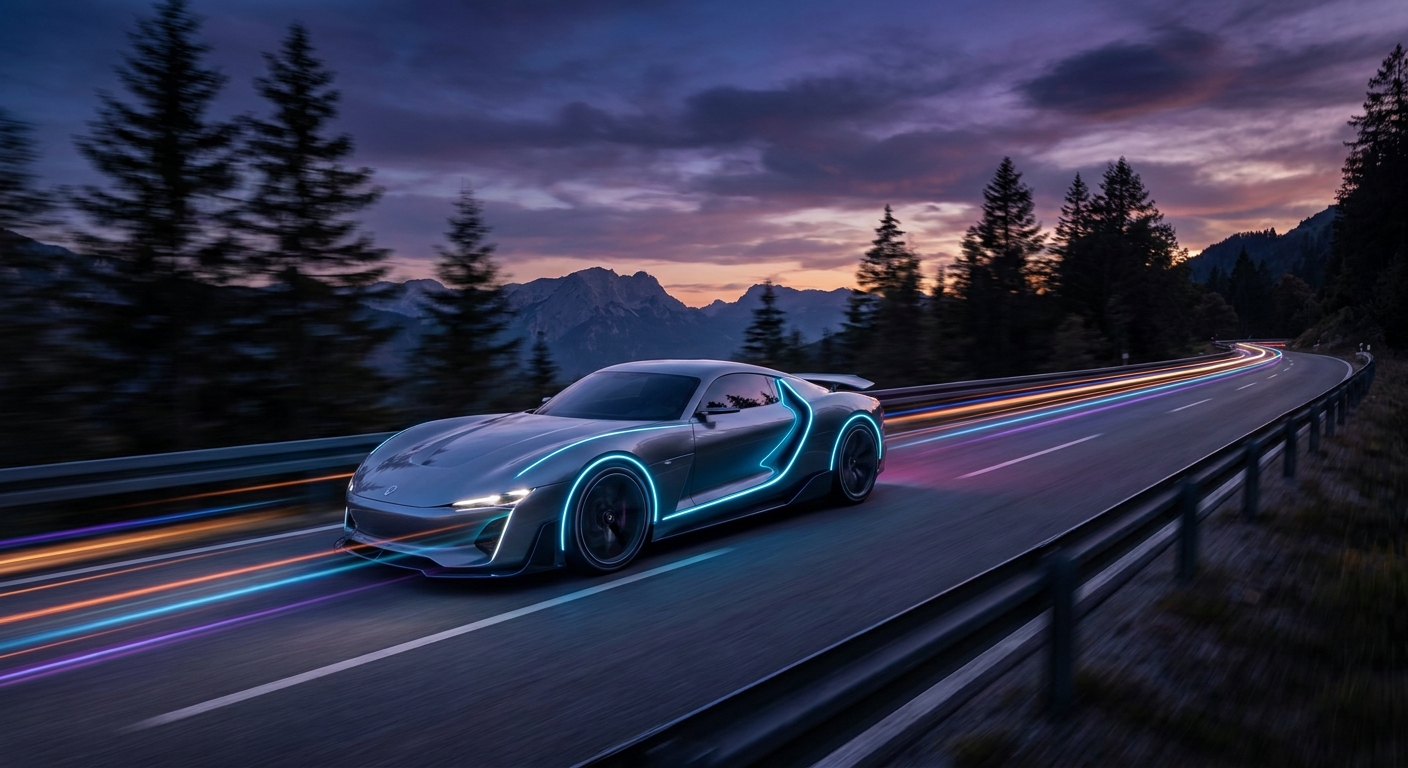
Why The Lexus LFA Successor Is Breaking The Internet
Have you seen the latest leaks about the Lexus LFA Successor? Seriously, man, I almost dropped my phone this morning. Sitting here in a cozy coffee shop near the Golden Gate in Kyiv, sipping on my flat white and scrolling through the forums, I got a notification that changed my whole week. We have been waiting over a decade for a proper follow-up to the screaming V10 masterpiece, and it is finally happening. The whole thesis of this new hypercar is wild: it is ditching the gasoline engine entirely but promises to keep the raw, emotional, neck-snapping connection that made the original so legendary. It sounds completely counterintuitive to everything we love about traditional supercars, but the engineers in Japan are literally rewriting the rulebook of physics.
I still remember standing on Khreshchatyk Street years ago, watching a YouTube video of the original car revving up, thinking nothing would ever beat that Yamaha-tuned acoustic perfection. Fast forward to today, and the conversation is totally different. The upcoming flagship isn’t just a nostalgic tribute; it is a battery-electric monster designed to dominate the future. You honestly have to see the sheer scale of engineering they are pulling off. From simulated manual gearboxes to next-generation battery chemistry, they are throwing the entire kitchen sink at this project to make sure it earns its halo status. Grab a coffee, sit back, and let me walk you through exactly why this machine is going to melt our minds.
The Core Dynamics: What Makes It So Special
Okay, let’s talk about the absolute madness of the specifications. You would think an electric vehicle might lose that visceral edge, but the development team is pushing boundaries we didn’t even know existed. They are targeting a 0-60 mph sprint in the low two-second range. That is hypercar territory, putting it right up there with the Rimac Nevera and the Pininfarina Battista. But sheer straight-line speed is cheap these days. What actually matters is how the car feels when you throw it into a corner, and that is where the magic happens.
The real value proposition of this machine lies in its software-defined architecture combined with ultra-low center of gravity mechanics. By utilizing advanced solid-state batteries, the weight distribution is remarkably better than traditional lithium-ion setups. You get instant torque vectoring to each individual wheel, meaning the car will literally pivot around your hips. It is going to feel telepathic. Imagine driving on a winding mountain road, and the car knows exactly how much power to send to the outside rear wheel before you even finish turning the steering wheel.
| Feature | Original 2010 Model | The Electrified Successor |
|---|---|---|
| Powertrain | 4.8L Naturally Aspirated V10 | Dual-Motor Battery Electric |
| Transmission | 6-Speed Single-Clutch Automated | Simulated Software-Defined Manual |
| 0-60 mph Time | 3.6 Seconds | Sub-2.0 Seconds (Estimated) |
| Range/Fuel | 19 MPG Combined | 435+ Miles (Solid-State Target) |
To fully grasp why the automotive community is losing its collective mind, you have to look at the three biggest innovations they are bringing to the table:
- The Simulated Manual Gearbox: They actually engineered a fake clutch pedal and gear shifter that physically stalls the car if you mess up. It provides tactile force feedback to trick your brain into thinking you are shifting mechanical gears.
- Aero-Driven Design: The bodywork isn’t just gorgeous; it is mathematically sculpted to generate massive downforce without relying on obnoxious, massive rear wings. It uses active aerodynamics hidden within the sleek body panels.
- Acoustic Engineering: They hired sound engineers to map the frequency of the electric motors, amplifying and tuning the natural electric whine into an aggressive, futuristic roar inside the cabin.
Origins Of The V10 Legend
You cannot fully appreciate the new project without paying respects to the grandfather. Back in the early 2000s, the top brass wanted a halo car to prove they could build something more exciting than reliable commuter sedans. They spent nearly a decade developing the 1LR-GUE V10 engine. They literally had to redesign the tachometer to be fully digital because the engine revved from idle to 9,000 RPM so fast (0.6 seconds) that an analog needle couldn’t keep up. It was a masterpiece of carbon fiber and aluminum. They only built 500 units, and they lost money on every single one of them. It was a passion project in the purest sense.
That level of dedication set an almost impossibly high bar. People thought the company would never attempt anything that crazy again. The carbon fiber looms they invented just for that chassis sat idle for years. But that DNA never really left the engineering department; it just went dormant, waiting for the right technology to come along to justify waking the beast.
Evolution Toward Electricity
Fast forward a bit, and the industry shifted dramatically. Combustion engines faced stricter regulations, and instant torque became the new metric for acceleration. In late 2021, we saw the covers pulled off the ‘Electrified Sport’ concept. I remember messaging all my car buddies, saying, “Look at this thing!” It had the long hood, the short rear deck, and the aggressive stance of a classic grand tourer, but there were no exhaust pipes. It was a huge statement. They were explicitly calling it the spiritual heir to their legendary supercar.
The design team focused heavily on packaging. Because electric motors are compact, they could sit the driver practically on the floor. They pushed the wheels out to the absolute extremes of the chassis, creating a footprint that screams stability. This wasn’t just a styling exercise; it was a physical manifesto of where their high-performance division was heading.
The Modern State Of Toyota’s Halo Car
Now that we are deep into 2026, the concept is rapidly becoming reality. Test mules wrapped in aggressive camouflage have been spotted terrorizing the Nürburgring. You can hear the tires screaming, but there is no engine noise—just a futuristic jet-fighter hum. The engineers are practically living at the track, tweaking the software that manages the torque distribution.
The modern focus is heavily on weight reduction. EVs are notoriously heavy, but they are using advanced carbon-fiber reinforced plastics (CFRP) to offset the battery mass. They are pulling tricks from their endurance racing programs to ensure the car doesn’t just go fast in a straight line, but can sustain high-G cornering lap after lap without thermal degradation. It is a completely different ballgame from building a V10.
Solid-State Battery Architecture
Let’s talk tech, man. The holy grail of this entire project is the solid-state battery. Normal lithium-ion batteries use a liquid electrolyte to move energy back and forth. They are heavy, they get hot, and they take up a ton of space. Solid-state replaces that liquid with a solid material. This sounds simple, but chemically, it is incredibly difficult to stabilize for thousands of charging cycles.
The benefits are absolutely massive for a sports car. You get double the energy density in the exact same footprint. That means you can either double the range or cut the battery weight in half. For a hypercar, less weight is the ultimate goal. The car aims to offer a range of over 400 miles while keeping the overall mass closer to a traditional combustion sports car rather than a three-ton electric SUV. It changes the driving dynamics entirely.
The Simulated Manual Transmission
I know what you are thinking. A manual transmission in an EV? It sounds like a cheap gimmick. But hear me out. The engineers literally mapped out the torque curves of combustion engines. The software artificially limits the electric motor’s output based on what “gear” you are in. When you press the physical clutch pedal and move the physical H-pattern shifter, the car simulates a mechanical engagement.
If you dump the clutch, the software creates a jolt. If you are in the wrong gear, it simulates a bog-down effect. You even get engine braking. It is an entirely optional mode you can turn on or off, but it exists solely to give the driver an emotional, tactile task to manage while driving.
- Drive-by-Wire Steering: There is no physical mechanical link between the steering wheel and the front wheels, allowing for dynamic ratio changes on the fly.
- Direct4 All-Wheel Drive: A dual-motor setup that calculates wheel slip in milliseconds, actively shuffling power front to back seamlessly.
- Thermal Management: Liquid-cooled power electronics designed specifically to prevent battery derating during hardcore track sessions.
- Silicon Carbide Inverters: Upgraded microchips that reduce energy loss by over 10% during heavy acceleration and regenerative braking.
Day 1: Study EV Powertrains
If you want to truly appreciate what is coming, you need to understand the basics. Spend your first day looking into how dual-motor EV systems actually function. Watch some videos on how an inverter converts DC battery power into AC motor power. Once you understand the sheer mathematical precision of electric torque, you will stop missing the mechanical throttle bodies of the past.
Day 2: Understand Solid-State Batteries
Next, dig into battery chemistry. Search up the differences between lithium iron phosphate (LFP), traditional lithium-ion, and solid-state. When you realize that solid-state tech reduces fire risks and significantly speeds up charging times, you will see why the manufacturer waited until this tech was viable before launching their flagship.
Day 3: Analyze The Simulated Manual Concept
Take some time to read the patent filings for the EV manual transmission. It is fascinating reading. The amount of code required to simulate a stalling engine, clutch slip, and rev-matching is staggering. It proves that the engineers care about the joy of driving, not just lap times.
Day 4: Track Nürburgring Lap Times
Go look at the current EV lap records at the Green Hell. The Rimac Nevera and Porsche Taycan are setting the benchmarks. Compare their weights and horsepower figures to the projected specs of the new Japanese flagship. You will start to see the exact target the engineers are aiming to destroy.
Day 5: Compare Against Rimac And Lotus
Look at the competition. The Lotus Evija and the Rimac Nevera are the current kings of the electric hypercar world. However, they cost millions of dollars. The Japanese alternative is aiming to bring hypercar-level technology down to a slightly more accessible (though still incredibly expensive) supercar price bracket.
Day 6: Evaluate The Acoustic Engineering
Sound is emotion. Check out interviews with acoustic engineers working on modern EVs. They are using internal cabin speakers to project synthesized frequencies based on motor RPM. It isn’t fake engine noise; it is an amplification of the actual electrical machinery working underneath you. It is a completely new genre of automotive sound.
Day 7: Plan Your Allocation Strategy
If you are actually crazy enough (and wealthy enough) to try and buy one, start building relationships with your local flagship dealerships now. These cars will be strictly limited production. Just like the original, you won’t be able to just walk in and write a check. You need purchase history, loyalty, and a bit of luck.
Myths vs. Reality
Myth: Electric sports cars are completely soulless appliances.
Reality: While standard commuter EVs can feel dull, hyper-EVs equipped with software-defined driving modes, simulated gearboxes, and aggressive torque vectoring offer an incredibly intense and engaging driving experience.
Myth: The new car will actually feature a twin-turbo V8 hybrid setup.
Reality: Despite early internet rumors hoping for a combustion safety net, official communications and patent filings confirm the halo vehicle is designed from the ground up as a strict Battery Electric Vehicle.
Myth: Solid-state batteries are vaporware and won’t be ready.
Reality: While delayed in the past, functional prototypes are actively being tested on tracks right now in 2026. The technology has finally crossed the threshold from the laboratory to real-world automotive applications.
Myth: It will be too heavy to handle well.
Reality: Advanced carbon composites and the weight savings of solid-state tech mean it will be significantly lighter than traditional EVs, maintaining extreme agility.
Will it have a real exhaust pipe?
No, it is a fully electric vehicle. Any exhaust-looking vents on the rear are strictly for aerodynamics and cooling the electric motors and battery pack.
How much will it cost?
While official pricing isn’t locked in, expect it to easily eclipse the $375,000 mark of its predecessor, likely sitting comfortably in the half-million-dollar range due to the battery tech.
Is it actually faster than the old V10?
In a straight line, it will absolutely obliterate the original car. The instant torque of electric motors provides acceleration that a naturally aspirated V10 simply cannot match mathematically.
Can you turn off the fake manual transmission?
Yes. The simulated manual is a selectable driving mode. You can switch it off and drive it like a standard, single-speed hyper-EV whenever you want to just cruise.
Who is designing the chassis?
The in-house performance division is handling the architecture, leveraging heavily off their Gazoo Racing endurance motorsport experience to ensure maximum chassis rigidity.
When will customer deliveries begin?
Current estimates point to limited production runs beginning within the next 18 to 24 months, with VIP allocations being finalized behind closed doors as we speak.
What makes it different from a Tesla Plaid?
A Model S Plaid is a heavy luxury sedan with massive straight-line speed. This is a bespoke, ultra-low, carbon-fiber hypercar designed specifically for track-day cornering and emotional engagement.
Wrap Up
Look, I get it. Saying goodbye to the howling V10 is painful. But after digging through all the patents, the engineering white papers, and the sheer dedication the team in Japan is pouring into this project, I am fully convinced. The Lexus LFA Successor isn’t just trying to replace a legend; it is trying to redefine what a hypercar can be in the electric age. It is packing mind-bending acceleration, revolutionary solid-state batteries, and a simulated manual gearbox that proves the engineers still care about the joy of driving. If you are as hyped as I am, share this breakdown with your car buddies, and let’s keep watching Nürburgring test footage together!





Leave a Reply