

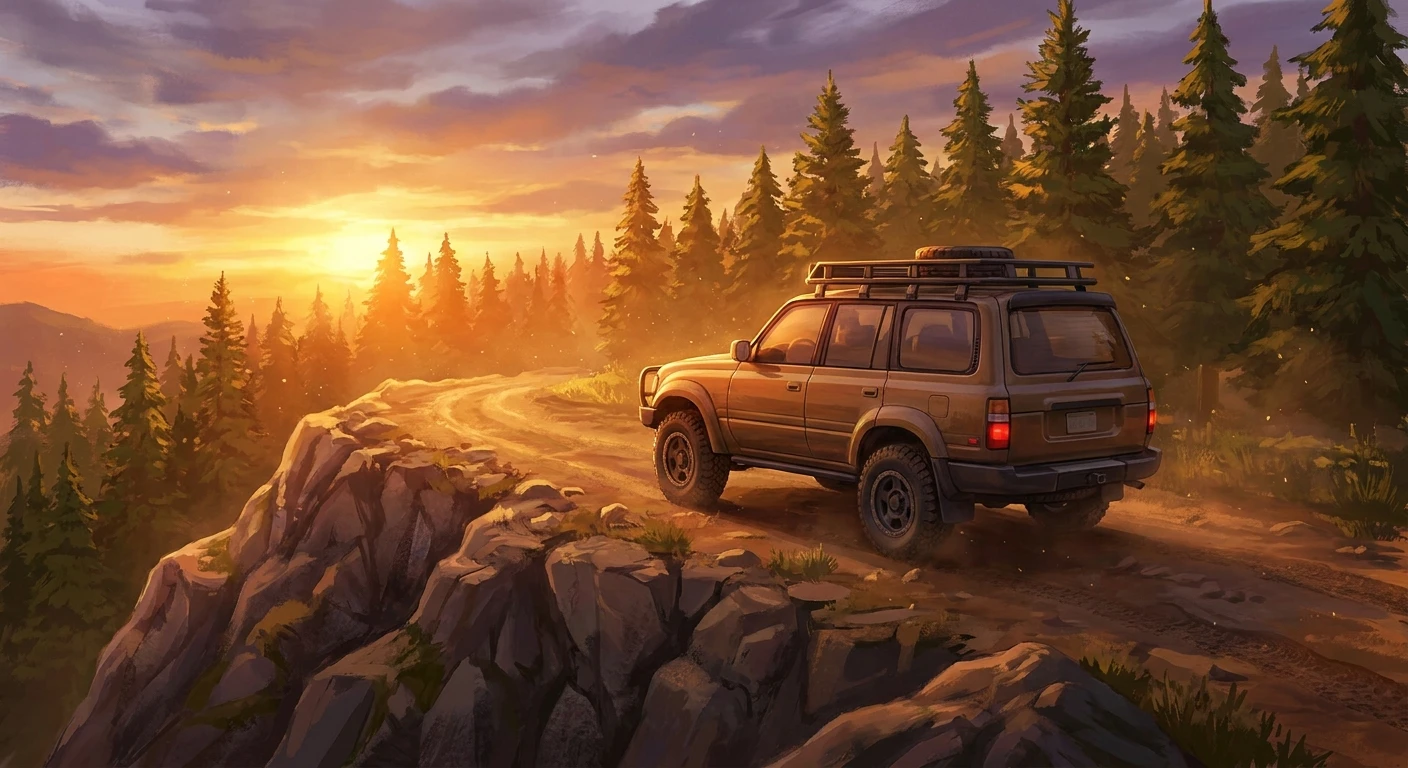
The Unfiltered Truth About the 2024 forester
Let me be straight with you: if you are looking at the 2024 forester right now, you are making a highly calculated move. The mid-size SUV market is an absolute jungle of identical-looking crossovers, but this specific model year stands out for a very specific set of reasons. I remember taking one up into the Carpathian mountains near Yaremche just last autumn. The rain was pouring down in sheets, turning the steep dirt trails into a treacherous slip-and-slide of thick clay and mud. Most typical front-wheel-drive crossovers would have been spinning their wheels, sliding backward into a ditch, waiting for a local farmer’s tractor to tow them out. But not this machine. It just grabbed the earth and climbed, completely unbothered by the miserable conditions.
That is the exact moment I realized why this vehicle maintains such a fiercely loyal following. It does not try to be a luxury sports car, and it does not pretend to be a massive heavy-duty truck. It occupies a perfect middle ground. You get the practicality of a daily commuter that easily fits into tight city parking spots, mixed with the rugged capability of a dedicated off-roader. It is a tool, a very well-designed tool, meant to get you and your gear wherever you need to go without making a fuss. I want to share exactly why the hype is real, what makes it tick under the hood, and how you can figure out if it is the right vehicle for your specific lifestyle.
Read also: Why The landcruiser 2025 Dominates The Trails; Epic 2024 colorado Specs & Review.
Core Benefits: Why This SUV Holds Up
When you break down the actual value of this vehicle, it comes down to a few core elements that competitors struggle to match. You are not just buying a car; you are buying engineering consistency. Let us look at a quick comparison to see how it stacks up against the general standard in its class.
| Feature Category | The 2024 forester | Average Competitor |
|---|---|---|
| All-Wheel Drive System | Full-time Symmetrical AWD | Slip-and-grip reactive AWD |
| Outward Visibility | Class-leading greenhouse design | Thick pillars with large blind spots |
| Ground Clearance | 8.7 to 9.2 inches (trim depending) | 7.5 to 8.0 inches |
| Engine Architecture | Flat-four Boxer (low center of gravity) | Inline-four (higher center of gravity) |
The true value proposition here lies in predictable capability. You have a vehicle that behaves exactly the same way on a dry, sunny highway as it does on a snow-covered backroad. Consistency breeds confidence. For example, when you are navigating the unpredictable, pothole-riddled streets of a busy city after a hard freeze, the suspension absorbs the impacts without unsettling the chassis. Another great example is weekend camping. You can pack a massive tent, a cooler, two dogs, and still have room for firewood, all while easily clearing rocks on the trail that would scrape the oil pan right off a normal sedan.
If you are on the fence, here are the main reasons people pull the trigger on this specific model:
- Unmatched Visibility: You sit inside and immediately notice how much glass surrounds you. It feels like a fishbowl in the best way possible. There are virtually no blind spots, which reduces driving fatigue immensely.
- Standard Safety Tech: The camera-based active safety suite watches the road like a co-pilot, gently keeping you in your lane and hitting the brakes if someone cuts you off.
- Resale Value: These things hold their value like gold. People know they run forever, so the used market is always hungry for them.
- Interior Ergonomics: Everything is exactly where you expect it to be. Physical buttons for climate control mean you do not have to tap a screen five times just to turn on the heat.
The Origins of the Nameplate
To really appreciate what we have today, we have to look back at where it all started. Back in the late 1990s, the automotive market was dominated by massive, gas-guzzling SUVs and traditional family station wagons. There was a huge gap in the market. People wanted the high seating position and tough look of a truck, but the driving dynamics and fuel economy of a car. The engineers took a proven rally-car chassis, lifted the suspension, squared off the roofline to maximize cargo space, and birthed a completely new category of vehicle. It was an instant hit among outdoor enthusiasts who needed a practical daily driver.
The Evolution of the Boxy Design
Over the decades, the design went through several phases. Early generations were essentially tall wagons. They had frameless windows and a very utilitarian aesthetic. By the mid-2000s, it started growing in size, adopting a more traditional SUV shape to compete with the rising tide of compact crossovers. But the designers never abandoned the core philosophy: form must always follow function. They kept the massive windows, the square rear hatch, and the low load floor. Every crease and line on the body was designed to maximize interior volume or improve aerodynamic efficiency, rather than just looking trendy for a year or two.
The Modern State of Compact SUVs
Fast forward to the current era, and the market is saturated. Every brand has a compact SUV, and most of them share the exact same sloping roofline that looks sleek but completely ruins rear headroom and cargo space. The 2024 model stuck to its guns. It resisted the urge to become a sleek, cramped crossover. It retained the upright, boxy posture that loyalists demand. It proves that you do not need to sacrifice utility for modern styling. It remains a testament to practical engineering in a sea of fashion-over-function alternatives.
Deconstructing the Boxer Engine
Let us talk mechanicals, specifically the heart of the beast. Most cars use an inline engine, where the pistons move straight up and down. This creates a tall, heavy block of metal sitting high up in the engine bay. The Boxer engine does things differently. The cylinders are laid flat, punching horizontally in opposite directions, like two boxers throwing punches at each other. This layout is brilliant for a few reasons. First, the engine is physically flat and sits very low in the chassis. This gives the SUV a much lower center of gravity, meaning it corners like a smaller car and feels incredibly stable at highway speeds, resisting body roll during sudden evasive maneuvers.
How Symmetrical AWD Actually Works
The term AWD gets thrown around a lot, but not all systems are created equal. The vast majority of crossovers on the road use a reactive system. They are front-wheel drive 90 percent of the time to save gas. When the computer senses the front wheels slipping on ice or mud, it suddenly sends power to the rear wheels. By the time that happens, you might already be stuck. The Symmetrical system is entirely different. It is full-time, meaning power is constantly flowing to all four wheels, all the time. The engine, transmission, and driveshaft are perfectly aligned down the center of the vehicle, creating perfect balance.
- Constant Power Delivery: Power is always actively searching for the wheel with the most grip, before slipping even occurs.
- Symmetrical Layout: Equal length axles mean no torque steer; the vehicle pulls dead straight under heavy acceleration.
- X-Mode Integration: A specialized computer program that alters the throttle mapping and transmission behavior to claw through deep snow or steep, muddy descents.
- Active Torque Vectoring: The system can lightly brake the inside front wheel during a sharp turn, pulling the nose of the car neatly into the corner.
Day 1: Assess Your Daily Mileage and Terrain Needs
Before you sign any paperwork, you need to be honest about how you drive. Track your mileage for a typical week. Are you mostly doing short grocery runs in the city, or are you racking up hundreds of highway miles? Do you frequently drive on unpaved roads, or live in an area with heavy winter snowfall? Writing this down helps you determine if the rugged capabilities are actually necessary for your lifestyle, or if you just like the idea of them.
Day 2: Compare the Available Trim Levels
This is where you need to do your homework. The base model gives you everything you need mechanically, but lacks creature comforts. Moving up the ladder gets you heated seats, a panoramic sunroof, and a better sound system. The rugged Wilderness trim adds a factory lift kit, all-terrain tires, and a different transmission cooler for towing. Make a list of your absolute must-have features so you do not get up-sold at the dealership.
Day 3: Schedule a Real-World Test Drive
Do not just drive it around the block. Tell the salesperson you need a proper test drive. Take it on the highway to test the merging power and wind noise. Find a bumpy, poorly maintained road to see how the suspension handles rough pavement. Try parallel parking to experience the visibility. You need to know exactly how it feels in the environments you navigate every single day.
Day 4: Analyze the Infotainment and Safety Tech
Spend twenty minutes just sitting in the driveway playing with the screens. Connect your phone via Bluetooth. Try using the voice commands. Fiddle with the adaptive cruise control buttons on the steering wheel. If the technology feels incredibly frustrating or distracting to use, that is going to annoy you every single day you own the car. Make sure the interface makes sense to your brain.
Day 5: Run the Long-Term Maintenance Numbers
Full-time all-wheel drive means you have extra differentials that need fluid changes. Boxer engines have a unique layout that can make spark plug changes a bit more labor-intensive. Call a local independent mechanic and ask them for a quote on a 60,000-mile service for this specific vehicle. Calculate your expected fuel costs based on the MPG ratings. Know exactly what this vehicle will cost you to run over the next five years.
Day 6: Hunt for Certified Pre-Owned Deals
Because these vehicles are incredibly durable, a one or two-year-old model with low mileage is often just as good as a brand new one, but significantly cheaper. Look for Certified Pre-Owned models at local dealerships. These come with an extended factory warranty that covers the engine and transmission for a very long time, giving you peace of mind while keeping money in your pocket.
Day 7: Negotiate and Finalize the Purchase
Armed with your research, go in and negotiate strictly on the out-the-door price of the vehicle, not the monthly payment. Be prepared to walk away if the numbers do not align with your budget. Remember that you have the upper hand. Stick to your preferred trim level and do not let them pressure you into buying expensive dealer add-ons like nitrogen-filled tires or questionable paint protection packages.
Myths vs. Reality
There is a lot of misinformation floating around car forums. Let us clear the air on a few persistent rumors.
Myth: The engine is dangerously slow for highway passing.
Reality: While it will not win a drag race against a sports car, the power delivery is linear and totally adequate for safe highway merging. The throttle is tuned to be responsive at low speeds, making city driving feel surprisingly punchy.
Myth: The continuously variable transmission (CVT) is fragile.
Reality: Early CVT technology had issues, but the heavy-duty, chain-driven unit used here is incredibly robust. As long as you change the transmission fluid at the recommended intervals, it will easily last the lifetime of the vehicle.
Myth: It is basically just a lifted station wagon.
Reality: It has nearly 9 inches of ground clearance, sophisticated off-road traction modes, and approach/departure angles that rival dedicated 4×4 trucks. It is a highly capable off-roader right off the showroom floor.
Myth: Fuel economy is terrible because of the full-time AWD.
Reality: Advanced aerodynamics and smart transmission tuning mean it can easily achieve over 30 miles per gallon on the highway, making it one of the most efficient AWD vehicles in its class.
Is it good in deep snow?
Yes, it is widely considered one of the best winter vehicles you can buy, thanks to the constant power delivery and balanced chassis.
Does it require premium gas?
No, it runs perfectly on standard 87 octane regular unleaded fuel, which saves you a lot of money at the pump over the years.
How long do the factory brakes last?
Depending on your driving style, you can typically expect 40,000 to 60,000 miles out of the original brake pads and rotors.
Can I sleep in the back?
Absolutely. If you fold the rear seats flat, there is enough room for two average-sized adults to roll out a sleeping bag comfortably.
Does it have wireless Apple CarPlay and Android Auto?
Yes, higher trims offer seamless wireless integration, so your maps and music connect the second you start the engine.
What is the towing capacity?
Standard trims can tow 1,500 pounds, but the rugged Wilderness edition doubles that to 3,000 pounds, perfect for a small boat or utility trailer.
Is the panoramic sunroof standard?
It is not on the base model, but it comes standard on the Premium trim and above, flooding the cabin with natural light.
Are there major blind spots?
No, the tall windows and narrow roof pillars provide the best 360-degree visibility of almost any vehicle on the market today.
Is it expensive to insure?
Typically, no. Thanks to its incredibly high crash test safety ratings and standard collision avoidance tech, insurance premiums are usually very reasonable.
Does the cabin get loud on the highway?
They have added significant sound deadening to this generation, making it much quieter at 70 mph than older models used to be.
Now that we are solidly in 2026, looking back at the automotive landscape, it is incredibly clear that this specific vehicle represented a peak era for practical, honest engineering. It avoided the trap of overly complicated, buggy tech in favor of reliable mechanical grip and safety. If you want a vehicle that will faithfully start every morning, easily plow through a blizzard, and comfortably take your family across the country, you really cannot go wrong. Stop wondering and go schedule a test drive today—you will understand the hype the moment you get behind the wheel!



Leave a Reply